
Mason’s bioengineering laboratories and centers are well equipped to lead the development of new medical treatments and technology that could revolutionize health care. Take a look at the capabilities and infrastructure available in our laboratories.
Labs in Peterson Family Health Sciences Hall
Bioinstrumentation Instructional Laboratory
This lab focuses on promoting and reinforcing classroom knowledge and skill development in electronics and bioinstrumentation through hands-on learning activities. The lab is equipped with workbench stations for bioelectrical and instrumentation activities including computers, data acquisitions systems, function generations, oscilloscopes, power supplies, multimeters, prototyping boards, and other measurement equipment. The space also contains soldering stations. In addition, there is a collaborative area for instruction, demonstration, and discussion with modular desks and AV capabilities. Principal investigator: Shani Ross. Lab manager: Randolph Warren. Peterson Family Health Sciences Hall, Room 5000E.
Biomedical Engineering Design Laboratory
This lab focuses on promoting translational activities from ideas to manufactured prototypes. This space is used primarily for senior design and other design projects and is equipped with prototyping, fabrication, and testing equipment including 3D printers, electronics testing stations, and a mechanical tester. There are areas for collaborative work including project assembly, discussions, and demonstrations. Off the main lab there is a 3D printing room for larger projects, a mechanical testing room, a machining/manufacturing room, and a biological testing space. This lab is also used for wet lab hands-on learning activities. Principal investigator: Shani Ross. Lab manager: Randolph Warren. Peterson Family Health Sciences Hall, Room 5000.
Biomedical Imaging Lab
This lab conducts translational research using imaging to investigate pathophysiology and function. One overarching focus is the investigation of brain-body interactions through imaging. In particular, we are studying the interactions between the central and peripheral nervous system and the musculoskeletal system in a number of clinical conditions of major public health significance, such as chronic pain, stroke, spinal cord injury, and amputation.
This interdisciplinary group conducts pre-clinical research for developing new technology and translational research on human subjects. The group uses state-of-the-art ultrasound and laser instrumentation for developing new ultrasound, optical, and hybrid imaging techniques.
Our research has potential applications in noninvasive diagnosis, screening, and treatment monitoring for a number of diseases, as well as for understanding underlying mechanisms of disease. Principal investigators: Siddhartha Sikdar and Parag Chitnis. Peterson Family Health Sciences Hall, Room 3300.
Computational Biomedicine Laboratory
This lab focuses on the development and application of computational models and techniques primarily in the areas of biofluids and biomechanics. Biofluids applications center on the patient-specific image-based modeling of blood flow in the brain and cerebrovascular diseases, such as aneurysms and stroke.
In particular, we combine in silico models, clinical observations, biological and mechanical tissue data to understand mechanisms of cerebral aneurysm disease, to enhance risk assessment and patient evaluation through data-based statistical modeling, and to evaluate devices and minimally invasive procedures to treat brain aneurysms and ischemic strokes.
Biomechanics applications include the study of disorders of the oculomotor and musculoskeletal systems. In particular, we focus on quantitative measurement of extraocular dynamics in vivo using ultrasound, studying pelvic floor dysfunction using ultrasound imaging and biomechanical modeling, studying the biomechanics of the rat hind limb to improve understanding of neural control, and examination of the coordination of extraocular muscles and biomechanics of strabismus. Principal investigators: Juan Raul Cebral, Vicky Ikonomidou, and Qi Wei. Peterson Family Health Sciences Hall, Room 4000E/F.
Neural Engineering Laboratory
Our main goal is to develop prosthetic devices or parts of devices to help people with disabilities, in particular with pathologies of the nervous system. The second area we work on is neuronal cell cultures and biosensors. Principal investigators: Nathalia Peixoto and Parag Chitnis. Peterson Family Health Sciences Hall, Room 4000.
Sensorimotor Integration and Human-Machine Interfaces Laboratory
This lab is part of the Center for Adaptive Systems of Brain Body Interactions (CASBBI). A key aspect of brain-body interactions is manifest in behavior. Perhaps the most ubiquitous example of this is the perception-action interactions that underlie motor behavior.
These interactions are constantly updated in response to experience—a process known as sensory-motor adaptation. Sensory-motor adaptation is critical for functioning successfully in one’s environment. The research methods pursued in this lab are broadly applicable to assistive technologies where physical systems, computational frameworks, and low-power embedded computing serve to augment human activities or to replace lost functionality.
Investigators examine experience-dependent changes that occur in both the intact and disordered sensory-motor system. Areas of study include the processes by which this adaptation occurs, its mechanisms, and relationships to functional disability and recovery. One focus within this group is the sensory-motor adaptation that occurs with motor practice in individuals with chronic hemiparetic stroke.
Another focus is the development and evaluation of novel bionic technologies such as upper extremity prostheses and hybrid exoskeletons, using wearable imaging sensors for sensing the human user’s volitional intent.
Addressing these issues requires a multimodal measurement approach that includes quantitative measurements of motor performance, muscle activation patterns and intramuscular architecture in health and disease, and corticomotor physiology, as well as standardized clinical assessments of impairment and function. Principal investigator: Siddartha Sikdar. Peterson Family Health Sciences Hall, Room 3300A.
Labs in the Krasnow Institute for Advanced Studies
Biomedical Imaging Laboratory
This lab uses novel applications of ultrasound. Optics are developed for diagnostic imaging, tissue characterization, sensing and mapping neurological function, localized drug delivery, and noninvasive thermal therapy. We focus on bench-top and pre-clinical research with emphasis on the development of new technology. Principal investigator: Parag Chitnis. Krasnow Institute for Advanced Studies, room 165.
Computational Neuroanatomy Group/Ascoli Lab
This lab in the Center for Neural Informatics, Structures, and Plasticity aims to create a real-scale, biologically realistic computer simulation of an entire functional portion of the mammalian brain at the detailed level of individual cellular connections.
We are especially interested in neuronal architecture and the circuit underlying associative memory. The computational models we develop are open-source and entirely data-driven, linking each parameter to an experimental observation in the peer-reviewed scientific literature. Our research has been continuously supported by the National Institutes of Health and other funding agencies since the last millennium. Principal investigator: Giorgio Ascoli. Krasnow Institute for Advanced Studies, second floor.
Spatial Cognition and Memory Laboratory
How is space represented in the brain? How do we form spatial memories? And how can we use spatial cognition and spatial memories to navigate in our environment? The spatial cognition lab of Dr. Holger Dannenberg uses a combination of experimental techniques including multiple single unit recordings, optogenetics, and fiber photometry in freely behaving mice to investigate the neural mechanisms underpinning spatial cognition, memory, and navigation. The multi-disciplinary research on brain mechanisms combines the expertise of biologists, electrical engineers, life scientists, physicists, and computer scientists. The lab records neurons in the brain’s spatial cognition and memory system, including grid cells in the medial entorhinal cortex, and investigates the functions and mechanisms of network rhythms as well as cholinergic neuromodulation in the context of memory-guided navigation. Visit dannenberglab.org to learn more about this research or to connect with the lab. Principal investigator: Holger Dannenberg. Krasnow Building.
Labs in the Institute for Advanced Biomedical Research
Biomaterials and Nanomedicine
This lab is equipped for biomaterials development in the areas of tissue regeneration and the delivery of novel nucleic acid therapeutics. Degradable polymers are being designed that interact in a specific manner with cells of the immune system and with blood to control inflammation and promote tissue regeneration. Bioactivities are evaluated using proteomics, in vitro cell culture assays and animal model systems. Novel cationic lipid libraries are synthesized to produce messenger RNA carrying lipid nanoparticles for vaccines, cancer treatments and protein replacement therapies.
A multidisciplinary team works from developing new compositions through characterization and screening studies, to identify those that can successfully translate to industry for clinical testing. Principal investigators: Caroline Hoemann and Michael Buschmann. Institute for Advanced Biomedical Research, 2nd floor.
Laboratory for Bio-Inspired Nanoarchitectures
This lab is used to design and synthesize new composite nanomaterials, combining structured DNA nanoparticles with macromolecular assemblies of proteins, peptides, and lipids.
We use these constructs to investigate fundamental questions about nanoscale organization of macromolecules with a focus on cell membrane molecular events, such as pathogen entry into cells and antigen recognition in B-cell activation. These new biomimetic nanoarchitectures also are used in the development of vaccines, delivery vehicles, and new materials for tissue engineering. Principal investigator: Remi Veneziano. Institute for Advanced Biomedical Research, 3rd floor.
Bioengineering Centers
Center for Adaptive Systems of Brain Body Interactions
The center’s researchers focus on transdisciplinary research questions of major public health and societal significance such as chronic pain, substance misuse and addiction, autism spectrum disorders, and mobility impairments.
Our goal is to develop improved clinical interventions and improved clinical outcomes for these conditions. The center brings together experts in neuroscience, physics, engineering, psychology, and rehabilitation to pursue convergent research involving the integration of knowledge across disciplines to uncover underlying neurobiological mechanisms of disability, to modulate them through novel technological approaches, and to develop measurement tools sensitive to changes resulting from the interventions.
The core methodological expertise is in multiscale neuromodulation and neuroimaging, human machine interactions, and sensorimotor integration and human movement. The core facilities include shared research instrumentation, core imaging facilities, shared wet and dry lab facilities on the Fairfax campus of George Mason University. Many of the center’s researchers have laboratory space in the newly opened Peterson Health Sciences Hall.
The center director is Siddhartha Sikdar.
Center for Neural Informatics, Neural Structures, and Neural Plasticity
Researchers with the center, referred to as CN3, pursue fundamental breakthroughs in neuroscience by integrating computational and experimental approaches to neuroplasticity and neuroanatomy.
By bringing together faculty expertise in engineering, bioinformatics, and cognitive science, the center provides opportunities for cross training in multiple disciplines.
Researchers investigate the relationship between brain structure, activity, and function from the subcellular to the network level, with a specific focus on the biophysical mechanisms of learning and memory. The labs combine electrophysiology, behavior, microscopy, and genetics with supercomputers for analysis and modeling.
The center director is Giorgio Ascoli.
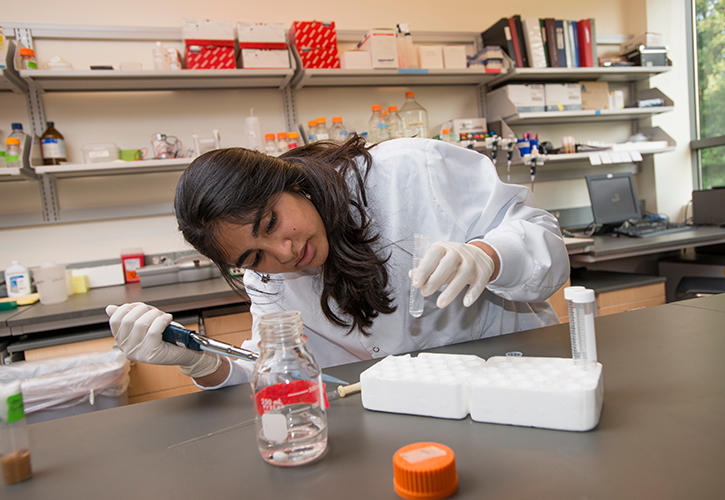
A student works in a lab during the Aspiring Scientists Summer Internship Program (ASSIP) at Fairfax campus.
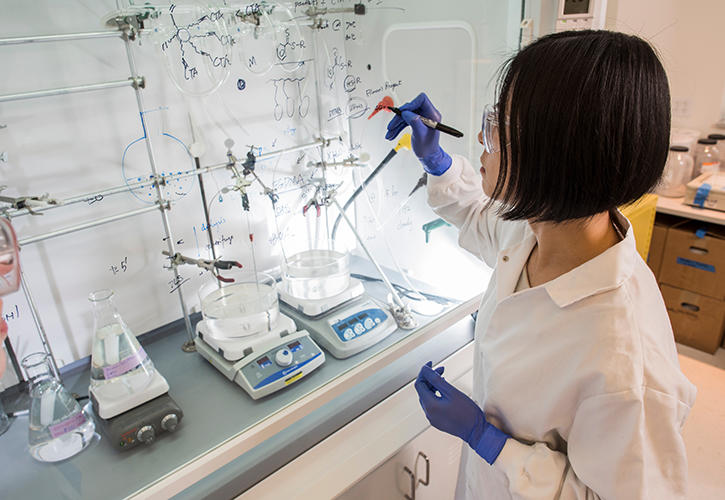
A PhD student at the Institute for Advanced Biomedical Research at the Science and Technology campus.